


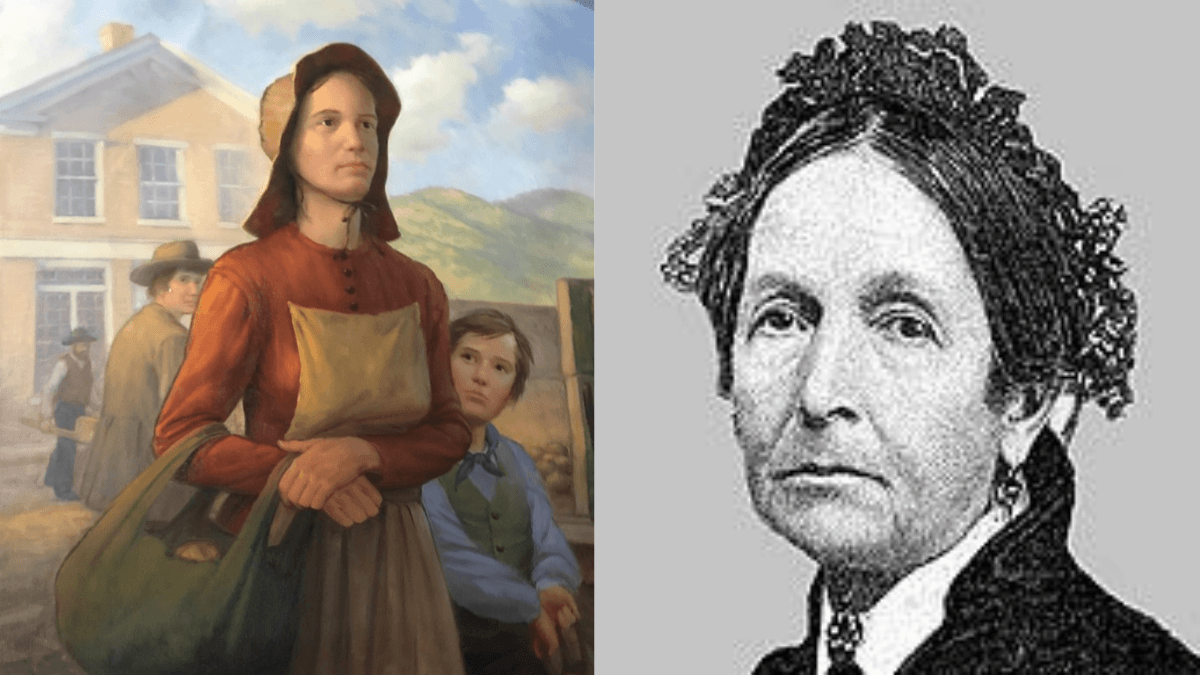
Mary Fielding Smith was an English-born pioneer remembered for her faith, courage, and dedication to her family. She became an important figure in the early history of The Church of Jesus Christ of Latter-day Saints and faced many hardships during her lifetime.
Born in 1801, Mary moved from England to North America and built a new life shaped by religion, family responsibilities, and migration. Her marriage to Hyrum Smith, the older brother of Joseph Smith, connected her to important events in the early Latter-day Saint movement. After her husband’s death, she continued caring for their children and preparing for a new life in the American West.
Early Life of Mary Fielding Smith
Mary Fielding was born on July 21, 1801, in Honeydon, Bedfordshire, England. She grew up in a religious household with her parents, John Fielding and Rachel Ibbotson. Her family’s beliefs played an important role in shaping her values and understanding of faith.
Although Mary did not receive a formal education like many people do today, she learned important skills at home. Her mother taught her reading, writing, religion, and other subjects that helped prepare her for adult life. These early lessons became valuable as Mary later managed a household and cared for a large family.
Mary spent much of her early life in England before deciding to join her brother Joseph and sister Mercy in North America. Her journey required leaving familiar surroundings and starting over in another country. This decision marked the beginning of a new chapter that would eventually connect her to the history of the Latter-day Saint movement.
| Detail | Information |
|---|---|
| Full name | Mary Fielding Smith |
| Birth name | Mary Fielding |
| Date of birth | July 21, 1801 |
| Birthplace | Honeydon, Bedfordshire, England |
| Father | John Fielding |
| Mother | Rachel Ibbotson |
| First husband | Hyrum Smith |
| Second husband | Heber C. Kimball |
| Children | Two biological children with Hyrum Smith |
| Known for | Faith, family devotion, and pioneer life |
| Date of death | September 21, 1852 |
| Place of death | Salt Lake City, Utah Territory |
Mary Fielding Smith’s Religious Faith
Mary Fielding Smith’s religious beliefs became central to her identity. In 1834, she traveled to Toronto, Canada, where her brother and sister were living. There, she encountered the religious teachings associated with the early Latter-day Saint movement and began exploring a different direction for her spiritual life.
Mary was baptized into the church on May 21, 1836. Her conversion influenced her future decisions, including her move to Kirtland, Ohio, in 1837. She joined other church members who were gathering in places where they could practice their beliefs and build a religious community.
Her faith was not simply a private belief. It influenced how she responded to family difficulties, separation, persecution, and uncertainty. Historical accounts and her surviving letters show that religion remained an important source of strength during some of the most difficult periods of her life.
Marriage to Hyrum Smith
Mary married Hyrum Smith on December 24, 1837. Hyrum was a prominent early Latter-day Saint leader and the older brother of Joseph Smith. His first wife, Jerusha Barden, had died in 1837, leaving him with five children who needed care and support.
By marrying Hyrum, Mary accepted responsibility for a household that already included several young children. She became their stepmother and helped provide the care they needed while the family faced religious conflict and frequent moves. Her role involved much more than maintaining a home because the family’s circumstances could change quickly.
Mary and Hyrum also had two children together: Joseph F. Smith and Martha Ann Smith. Their family life, however, was affected by the wider challenges facing Latter-day Saint communities during the 1830s and 1840s. Hyrum’s religious leadership brought periods of separation and danger that placed additional responsibilities on Mary.
Challenges During the Missouri Years
The family’s move to Missouri brought serious difficulties. During the conflict involving Latter-day Saint settlers and other residents, church members faced threats, forced displacement, and violence. Mary had to care for her children while dealing with an uncertain future.
In 1838, Hyrum was imprisoned in Liberty, Missouri, alongside other church leaders. Mary was left to manage family responsibilities during his absence. She was also dealing with the demands of pregnancy and the challenges of living in a community affected by persecution.
Her son Joseph F. Smith was born in November 1838 while Hyrum remained imprisoned. The family eventually left Missouri and moved to Illinois, where Hyrum later reunited with them after escaping custody in 1839. These events demonstrated the difficult circumstances under which Mary raised her children and maintained her household.
Life After Hyrum Smith’s Death
Mary’s life changed dramatically on June 27, 1844, when Hyrum Smith and his brother Joseph were killed by a mob at Carthage Jail in Illinois. Hyrum’s death left Mary a widow with young children and a family to support during a period of uncertainty.
Rather than abandoning the future she had built with her family, Mary continued working to protect and provide for her children. She had to consider their practical needs while coping with personal grief. Historical records also show that she accepted responsibility for administering her husband’s estate, reflecting the legal and financial duties she faced after his death.
In 1844, Mary married Heber C. Kimball as a plural wife, in keeping with the marriage practices of the early Latter-day Saint community. This marriage later connected her family to the preparations for migration to the Salt Lake Valley. Her life continued to revolve around family responsibilities and her religious commitments.
Mary Fielding Smith’s Journey to Utah
After the deaths of Joseph and Hyrum Smith, many Latter-day Saints prepared to leave Illinois and travel west. Mary was determined to make the journey with her children, despite the physical demands and uncertainty associated with traveling across the plains.
The westward migration required careful preparation, patience, and the ability to manage limited resources. Families traveled in groups, carrying supplies and caring for children and livestock along the way. For Mary, the journey represented another major test of her determination and commitment to her family.
Mary and her family reached the Salt Lake Valley in 1848. Settling in a new region brought opportunities to establish a home, but life remained difficult. The community needed to build homes, grow food, and develop the resources required for survival. Mary continued working to create stability for her children in their new surroundings.
Children and Family Legacy
Mary Fielding Smith is especially remembered for her role as a mother. She raised her two biological children with Hyrum Smith while also caring for the five children from his first marriage. Her responsibilities extended beyond her immediate relationship with her husband because she helped maintain a large household through repeated periods of hardship.
Her son Joseph F. Smith later became the sixth president of The Church of Jesus Christ of Latter-day Saints. Her grandson, Joseph Fielding Smith, later became the church’s tenth president. These family connections contributed to Mary’s lasting place in the institution’s history.
However, her legacy is not limited to the achievements of her descendants. Her own life illustrates the responsibilities women carried during periods of migration, religious conflict, and community building. She helped preserve family life while adapting to circumstances that were often beyond her control.
Why Mary Fielding Smith Is Remembered Today
Mary Fielding Smith remains an important figure in accounts of early Latter-day Saint history. Her life reflects the experiences of women who supported their families while participating in the migration and settlement of new communities. Her story also provides insight into the challenges faced by religious converts during the nineteenth century.
Her faith, family responsibilities, and determination are central themes in historical accounts of her life. Surviving records, including letters and administrative documents, help researchers understand her experiences beyond the basic dates and events of her biography.
Mary died on September 21, 1852, in Salt Lake City, Utah Territory, at the age of 51. Although her life was relatively short, her influence continued through her children, grandchildren, and the historical memory of the early Latter-day Saint community.
Frequently Asked Questions
Who was Mary Fielding Smith?
Mary Fielding Smith was an English-born pioneer and an early member of The Church of Jesus Christ of Latter-day Saints. She was the wife of Hyrum Smith and the mother of Joseph F. Smith and Martha Ann Smith.
When was Mary Fielding Smith born?
Mary Fielding Smith was born on July 21, 1801, in Honeydon, Bedfordshire, England. She spent her early years in England before immigrating to North America.
Who was Mary Fielding Smith’s husband?
Her first husband was Hyrum Smith, whom she married in December 1837. After his death in 1844, she married Heber C. Kimball as a plural wife.
How many children did Mary Fielding Smith have?
Mary had two biological children with Hyrum Smith: Joseph F. Smith and Martha Ann Smith. She also helped raise Hyrum’s five children from his first marriage.
5. Was Mary Fielding Smith the mother of a church president?
Yes. Her son, Joseph F. Smith, became the sixth president of The Church of Jesus Christ of Latter-day Saints. Her grandson, Joseph Fielding Smith, later became the tenth president.
Why is Mary Fielding Smith famous?
She is remembered for her religious faith, her role in raising a large family, and her determination during difficult periods of persecution and migration. Her journey to Utah is an important part of her historical story.
When did Mary Fielding Smith die?
Mary Fielding Smith died on September 21, 1852, in Salt Lake City, Utah Territory. She was 51 years old.
What is Mary Fielding Smith’s legacy?
Her legacy includes her contributions to her family and the early Latter-day Saint community. Her experiences also provide a historical example of the responsibilities and hardships faced by pioneer women during the nineteenth century.

2 Comments
Pingback: How Body Temperature Changes During Sleep What to Know - Paperomagazine
Pingback: Morgan Nicole Cruse Miller Biography, Family, Education, and Personal Life - Paperomagazine