


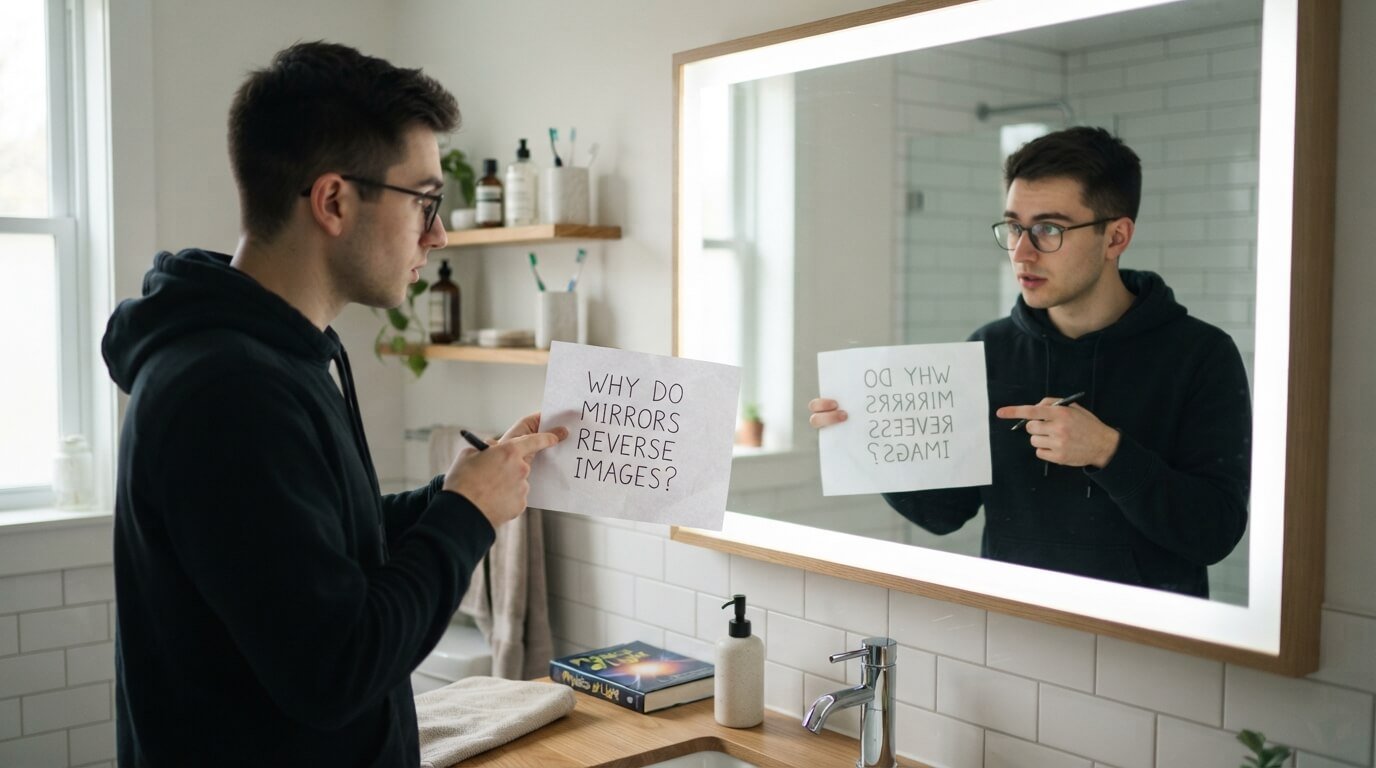
When you check out a replicate, your reflection seems almost exactly together with you, but a few element feels one-of-a-kind. Your face is upright, however terms on your shirt appear backward. If you raise your left hand, the mirrored image appears to raise its proper hand. This normal effect ends within the common question: why do mirrors opposite pictures?
The thrilling component is that a flat replicate does not truly trade left and proper. Instead, it reverses the course that factors inside the course of and faraway from the reflect. Our viewing role makes that trade appear to be a left-proper reversal.
Why Do Mirrors Reverse Images?
The simplest solution to why do mirrors reverse photos is that a mirror reverses the the front-to-again course of an object. It does now not physically switch the item’s left facet with its right facet.
Imagine standing in the front of a replicate. Your body has 3 instructions: left and right, up and down, and back and front. The replicate modifications the front-returned route due to the fact mild travels from you toward the reflect after which displays back toward your eyes.
Your mirrored image therefore appears to be standing at the back of the reflect, going through you. The image is virtual because light does now not absolutely travel behind the mirror. Instead, your eyes interpret the meditated rays as coming from a location at the back of the reflect.
| Feature | Mirror Image |
|---|---|
| Image type | Virtual |
| Orientation | Upright |
| Size | Same as object |
| Apparent change | Left-right reversal |
| Image location | Behind the mirror |
| Light behavior | Reflection |
Does a Mirror Really Reverse Left and Right?
A reflect does no longer literally trade your left facet and right facet. This is one of the most commonplace misunderstandings about reflections.
If you raise your left hand, the photo shows a hand on the alternative facet from your standpoint. Because the contemplated character seems to stand you, your brain compares the two bodies as although one character has grew to become around to stand the other. That exchange in perspective creates the impression of left-proper reversal.
A beneficial manner to understand that is to assume turning round and going through someone. Your left side might seem opposite their proper aspect from your angle. The mirror produces a similar alternate in orientation without actually moving your left and right sides.
Why Do Words Look Backward in a Mirror?
Words offer one of the clearest examples of the effect. If you stand in front of a mirror carrying a blouse with ordinary writing, the letters seem reversed.
For example, the word AMBULANCE is typically written backward at the front of emergency vehicles. Drivers then see the phrase successfully when they test the car through a rear-view replicate.
The important point is that the mirror is not taking normally shaped letters and physically turning each one around. The orientation of the writing relative to the observer changes when the reflected image is viewed.
This is why some symmetrical words can look unchanged. A word such as “BOB” can appear the same in a mirror because its letter arrangement has visual symmetry, although the individual shapes are still reflected.
Why Does a Mirror Not Turn You Upside Down?
If mirrors reversed everything, you might expect your reflection to appear upside down. But that does not happen with a normal flat mirror.
Your head remains on the top of the reflection and your ft stay at the bottom. This occurs due to the fact the replicate does not opposite the vertical path. It modifications the path perpendicular to its floor, which is the front-again path whilst you stand without delay in front of it.
This explains an essential distinction among an apparent left-proper reversal and an actual top-backside inversion. A standard plane reflect produces an upright photo in place of an upside-down one.
How Does Reflection Create a Mirror Image?
Light makes the whole process possible. Light travels from an object closer to the replicate, strikes its surface, and reflects in the direction of your eyes.
The contemplated mild follows the law of reflection, in which the angle at which light approaches the replicate is identical to the attitude at which it leaves the surface. Your eyes get hold of those pondered rays and your brain interprets their route.
If the reflected rays are extended backward, they appear to come from a position behind the mirror. This apparent location is where the virtual image seems to exist. The image is not physically sitting behind the glass.
Why Is the Mirror Image the Same Size?
A flat reflect commonly produces an image that has the same dimensions because the object. If you stand in the front of a plane replicate, your mirrored image seems to have the equal peak and widespread proportions as you do.
The photograph also appears to be the same distance at the back of the mirror as you’re in the front of it. For instance, if you stand three ft from a plane reflect, your image appears three feet in the back of the reflect, making the plain distance among you and your photograph six toes.
This predictable courting is one purpose aircraft mirrors are useful for understanding primary reflection and photograph formation.
Why Do Mirrors Seem to Change Perspective?
Perspective plays an vital function inside the way we interpret reflections. When you look at once at yourself, you are seeing a person going through you as opposed to seeing yourself from at the back of.
That difference in viewpoint makes the mirrored image seem as though its left and right facets have switched. In physics, this is regularly defined as an obvious left-proper reversal instead of a simple bodily trade of left and proper.
Think about conserving a sheet of paper with writing on it while dealing with a replicate. The orientation of the writing relative to you and the replicate adjustments how the letters are perceived. The identical simple concept explains the writing on clothing.
Are All Mirrors the Same?
Not every mirror produces exactly the same type of image. A flat or plane mirror creates an upright virtual image that is generally the same size as the object.
Curved mirrors behave differently. Concave mirrors can produce either real or virtual images depending on where the object is positioned. Their images can also be larger, smaller, upright, or inverted.
Convex mirrors generally create virtual images behind the mirror and are commonly used when a wider field of view is useful. Their curved surface changes the paths of reflected rays compared with a flat mirror.
A Simple Way to Understand Mirror Reversal
The easiest mental model is to stop thinking of a mirror as swapping left and right. Instead, imagine that it reverses the direction pointing toward the mirror.
You stand in front of a mirror. Your body faces the mirror. The image you see looks like it is behind the mirror and its front side points toward you. why do mirrors reverse images his change from front, to back is what makes the image seem reversed.
So why do mirrors reverse images? They don’t actually flip left and right. A flat mirror reverses the depth direction. The front-back axis.. Because you are looking at the reflection your brain interprets this reversal as a left-right swap. Once you realize that the mirror changes front and back not left and right the odd behavior of mirrors becomes much clearer.
Frequently Asked Questions
Why do mirrors reverse images?
Mirrors reverse the front-back direction of an object. Because you view the reflection from the opposite side, this change appears to be a left-right reversal.
Do mirrors actually swap left and right?
No. A plane mirror does not physically exchange left and right. The apparent left-right reversal comes from the change in viewpoint and the front-back reversal produced by reflection.
Why is mirror writing backward?
Writing appears backward because the reflected image has its orientation reversed relative to the observer. This makes ordinary text difficult to read in a mirror.
Why is a mirror image upright?
A plane mirror reverses the direction perpendicular to its surface but does not reverse the vertical direction. Therefore, your head remains at the top and your feet remain at the bottom.
Is a mirror image real?
The image produced by an ordinary plane mirror is virtual. Light does not actually travel behind the mirror. Instead, reflected rays appear to come from that location.
Why does my reflection have the same size as me?
A plane mirror normally produces an image with the same dimensions as the object. Its apparent distance behind the mirror is also equal to the object’s distance in front of it.
